
Two Secrets Teach A Child How to Ride A Bike
“He was kicking and screaming on our way here.”
These were the mother’s first words to me as she and her eight-year-old son arrived. She said she told him on the way over that he was going to bicycle lessons. Mother knew that if her son knew beforehand that someone was going to teach him how to ride a bike, he would not get into the car.
Not all children are interested and excited to learn.
Why teach children who do not want to learn? Parents have several important reasons. The mother of the boy mentioned above wanted to go on family rides around their neighborhood, town, and on vacations.
Other families’ reasons include wanting their children to: ride with friends for socializing and more independence; ride to and from school to relieve parents of drop-off and pick-up; and have access to a healthy activity.
Why children don’t want to learn how to ride a bike.
“I don’t want to ride a bike, I can use my scooter,” said a ten-year-old student. When children tell me they don’t want anyone to teach them how to ride a bike, here’s what I hear: “I’m afraid to learn.”
In my experience, the two most common reasons for their fear is:
- They fell in the past when learning how to ride, or
- They fear falling — despite never sitting on a bike.
How do we overcome this?
Secret #1
Build children’s trust in their body.
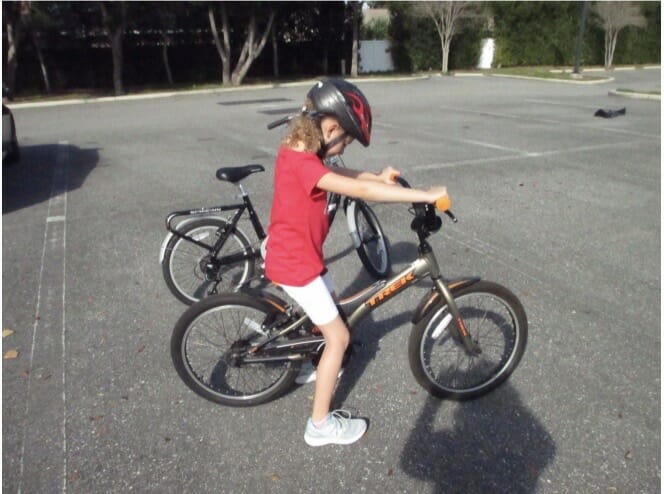
Keeping her feet flat on the ground while she walks the bike forward, Gabby gets to experience the sensation of leaning without falling.
My students and I remove their training wheels and pedals and lower their seat so their feet rest flat on the ground when they sit.
I assure them that their feet will keep them from falling as they walk the bike forward and experience the sensation of leaning without falling.
Eventually, they learn to trust their body. It’s at this point when lessons become fun. Students are now motivated and excited to learn.
Secret #2
The second secret has nothing to do with the child you’re teaching, yet everything to do with you:
Be calm, present and patient.
This is key to decreasing children’s fear and boosting their confidence. Your calm and patient presence helps them maintain the desire to continue working while they experience unfamiliar sensations and new ways of using their bodies.
Especially when children are learning a challenging new activity, our demeanor — as teachers, parents, and adults — very much influences their responses to instruction.
Having difficulty teaching your child how to ride?
Many of my students’ parents tell me that they’d rather have someone else teach their child. Their child may refuse to sit on a bike, or not want the training wheels removed. Many parents simply aren’t sure how to progress their child to the next step. Parents may recognize they don’t have patience or want to avoid arguments with their children.
If your child is having difficulty learning or you would just rather have someone else teach your child how to ride a bike, seek out a bicycle teacher. Let the teacher do the hard work, while you relax, cheer on your child, and take photos.
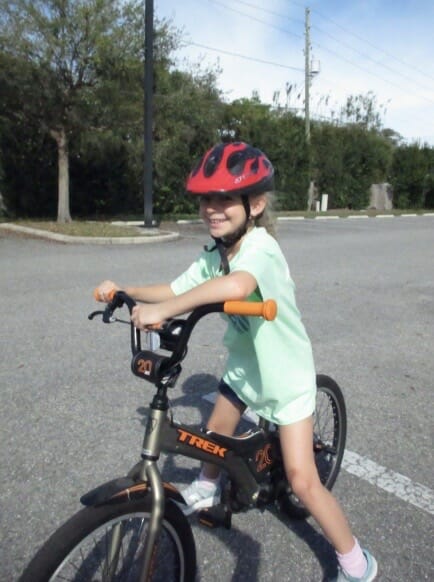
Feeling happy and confident, Gabby is now a member of our biking family.


Having spent a few years as a bike shop guy, I’ve been invited to help people learn to ride a bike “from scratch” a time or three. As a long-time fan of recumbent bicycles, and as a guy who sold them in the bike shop where I worked, I had to learn how to teach people to make that shift, as well.
I’m happy to report that on at least a few of those times, my intuition put me pretty close to where Tammy Bishop would have me, even if I didn’t articulate the two points as well.
Yes, it IS about helping the person trust themselves, and yes, it most assuredly helps if I am calm and patient and encouraging.
Thank you, Keri, and thank you, Tammy!
I started a youth learn to ride program through our local community center. We use the pedals off/feet flat on ground method. We strive to make it really fun, using animal movements to encourage the kids. First, they “lizard”. When they are lizarding well (i.e., gliding with balance), we have them move to “bunny rabbit” where they propel themselves with both feet up until they’re gliding with control for 15-20 feet at a time. Then we add one pedal (power pedal) and teach them to use that for propulsion while pulling the other foot up to “flamingo” (getting them ready for adding that other pedal. One thing that helps a great deal is that our program provides the bikes to use which has a pedal rollback feature for resetting power pedal (they’re actually bmx bikes). If they’ve brought their bike, we get them going on our bikes and then transition them to theirs. We teach them stopping and starting and talk about safety. We have a high success rate and find that if the parents are encouraged to sit on the sidelines without comment, the kids do better. Oh – and we tell parents that if the child complains about “discomfort in their delicate parts” later, a soothing bath will help. :-)
Ooooo, love the Flamingo. Getting that second foot up to the pedal is often a barrier. This breaks it down into 2 steps.
I can’t wait to use it!
Great advice on teaching new riders! One key thing about the choice of bike — it needs to have at least one hand brake; since the pedals are removed, a coaster brake can’t work.
It’s good to get the student (not always a child!) used to using the brake as soon as they’re dog-paddling the bike. Crashing due to an inability to stop is something you want to avoid.
With our grandchildren, I began by buying a $10 balance bike at a garage sale, and I’m positive this is the easiest way to teach that balancing reflex. But for motivation, I used a rare treat: Screen time!
Kids have an unfortunate compulsion to look at screens, and we normally resist that. But I let the three-year-old watch YouTube videos of kids on balance bikes as often as he asked. The inspiration worked! Coasting down gentle hills, then paddling along sidewalks progressed to competent scooting and balancing.
Once he was scooting and balancing well, a pedal bike with 12″ wheels was an easy transition at age 4. Little sister followed joyfully in older brother’s footsteps. They’ve loved riding ever since.
This technique is used by most if not all the bike shops in the Jacksonville area. While I no longer ride or teach Cycling Savvy, Jodi and I are involved with a couple of Kids Bicycle Rodeos each years. When I see a kid struggling on a bike, I tell the parents of this technique and they have been very appreciative.
Nice to see a Savvy Cyclist post. Just one quibble: I prefer the term “learn to balance and steer” over “learn to ride a bike.” As my friend Sheldon Brown used to say, “many people think that they know how to ride a bike once they can ride around the block without falling off.” There is so much more to learn!
Great stuff Tammy!
NICA, the high school and middle school MTB leagues across the U.S., also take great care in assuring the student athletes feel comfortable and safe in their riding and racing!
They make sure the riders are first SAFE, that’s its educational, and lastly FUN!