
Aiming for good bicycle lighting
We are now in the time of short days and long nights, and so it’s a good time to talk about bicycle lights.
And there’s good news. Thanks to efficient light-emitting diodes (LEDs), bicycle lights can be bright while drawing meager power from a small battery or generator.
Even better news — they won’t draw all the cash out of your wallet.
Like the horsepower race…
The trend can go to excess. Some of today’s bicycle headlights have product names like “Atomic”, and I kid you not, “Blinder” — only too true. Brighter, brighter, brighter… 200, 400, 1000 lumens. (The lumen is a measure of light output.)
The lumen war reminds me of the mid-20th-century horsepower race among big American cars. As in “my car is better than yours because it has a V8 engine with more horsepower!”
Why beam pattern matters
Lumens count light in every direction, but it matters in which direction the light goes. Any bicycle headlight bright enough to light your way should have a special beam pattern, like a car headlight, for at least four reasons:
- Efficiency: There is no point in using electrical power to produce wasted light.
- Clarity: Light thrown upward illuminates dust, fog, mist, rain, snow — washing out the bicyclist’s view of the riding surface.
- Glare reduction: a headlight that spews light upward glares into the eyes of oncoming bicyclists, motorists and pedestrians. Stray light from a properly-designed headlight is still bright enough to reveal you.
- Even illumination: a well-designed, shaped headlight beam tapers down in brightness closer to the bicyclist, avoiding a hotspot.
Good bicycle lights have shaped beam patterns
A good beam pattern looks more or less like this, if you shine the light at a wall:
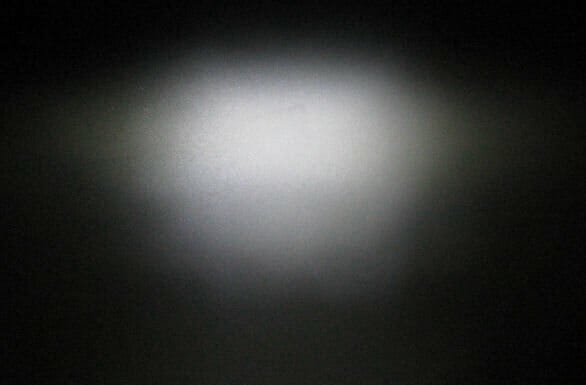
Germany’s bicycle lighting standard recognizes this. Several brands of bicycle lights with a shaped beam pattern are available, meeting the German standard. Increasingly, the German standard is being adopted by manufacturers in other countries as well.
Still, many bicycle headlights being sold in the USA have a round beam pattern like the one shown below. These headlights cannot illuminate the riding surface evenly without glaring at eye level and above.These lights are appropriate only for off-road riding, and even then not when there is oncoming traffic.. Some lights do let you switch beam patterns.
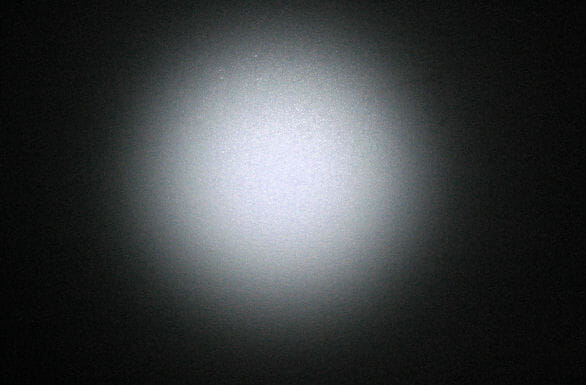
Any bicycle headlight should throw some light to the sides, to render the bicyclist visible to cross traffic.
Aiming a headlight
For a shaped beam to work correctly, the cutoff needs to be just below horizontal. Check out this video of the beam from my headlight as I walk my bicycle toward my garage. The flat top of the beam slowly rises up the garage door.
Aiming a taillight
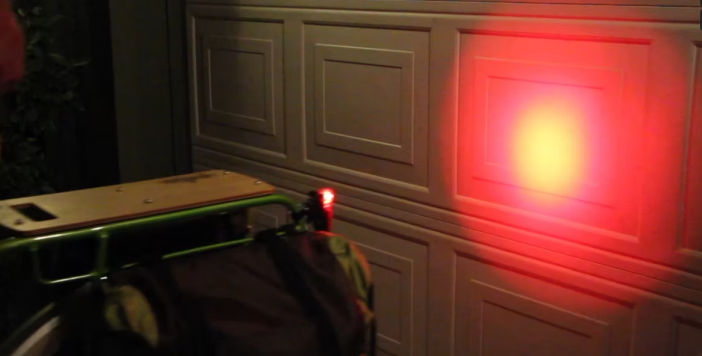
A taillight’s beam pattern is less critical. Drivers who can approach at speed will be directly behind you. Aim a taillight level and directly to the rear. As the video shows, you test aim by rolling the bicycle away from a wall. The center of the beam should stay in the same place. The taillight should throw light to the sides too, but need not be as bright there. The headlight and any side-facing reflective material will also be visible from the sides.
What about flashing mode?
A flashing headlight is useful in daylight and at dusk but should be avoided in full darkness for three reasons: 1) it’s difficult for motorists to judge your speed and location from a flashing light; 2) a flashing headlight announces that you are on a bicycle = SLOW. This could inspire motorists to violate your right-of-way. 3) an ultra-bright white LED on a flash pattern could cause a seizure in someone who is vulnerable them.
A flashing taillight also announces that you are on a bicycle, and that is a good thing for motorists to recognize when approaching from behind. It’s best to use a rapid flash pattern for the taillight. If you have two taillights, you can use one on flash mode and one on steady mode.
Good bicycle lights for daytime use?
Some bicyclists, especially those who ride on rural roads, use lights during daylight hours, to be more visible. To be noticed, lights have to be much brighter during the day than at night. Any light used for both day and night should have a different mode for each.
You might ask “isn’t the round beam pattern better for daytime use?” Well, no. To make a shaped-beam headlight work as a daytime running light, re-aim it a bit higher. A shaped-beam headlight also generally has a wider beam pattern than one with a round beam pattern, making it stand out for drivers farther from straight ahead.
More general information
More general information about lights can be found in John Brooking’s article on this blog.







A properly shaped headlight beam has terrific benefit, allowing the rider to see road hazards much better. I remember leading a nighttime ride during which one friend said “I want to ride next to Frank! His headlight is great!” She was talking about my Busch & Muller Cyo, powered by my 3 Watt generator. Her battery light had far more lumens, but low quality optics. Optics rule!
Good headlight beam patterns used to be the province of high-end lights, like the one Frank Krygowski mentioned in his comment. Fortunately for us bottom-feeders, the concept has trickled downward. About five years ago, I had a chance conversation with a Bell Sports executive, and he told me that all their lights sold in discount department stores would have a shaped beam pattern.
Nice article! Thanks, John!
Good article, John. Here in Ontario flashing white headlights are illegal, for good reasons. As you already stated, the flashing mode can cause seizures (and migraines). Also, flashing lights are reserved for emergency vehicles. This came home to me while cycling home one night and drivers pulled over to the side of the road and stopped for me. The Ontario Highway Traffic Act was amended to allow flashing red taillights. But I would never use a flashing front light.