
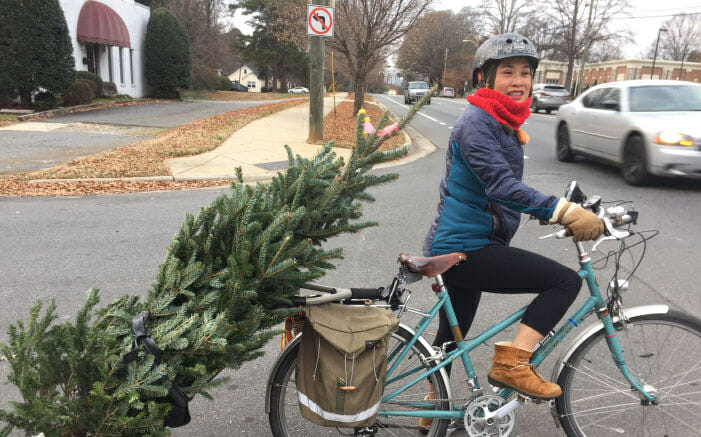
My All-Weather Cycling System
[Editor’s note: Pam Murray, author of this article, is too humble to mention that she rode more than 6,600 miles in 2020. She couldn’t have done that if she weren’t comfortable year-round!]
I love riding my bike year-round.
Through the years, I’ve had to figure out how to dress for all-weather cycling. I ride daily, so first I had to conquer the cold, then the wind, then the heat, then the wet. It’s been a process with lots of trial and error, and observation.
It doesn’t get as cold in the North Carolina Piedmont as in those “M” states (Maine, Michigan, Massachusetts…) But we do have winters here.
No sweat.
A few years ago I bought a lot of jackets and stuff. I thought if I just piled on the clothes, I’d stay warm. Well, I got hot! I sweat when cycling, in the summer and the winter.
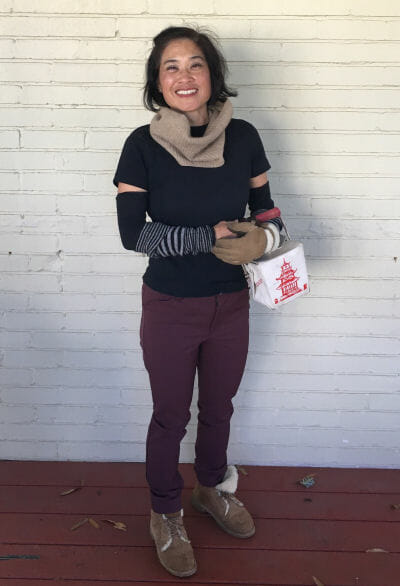
50-ish weather — T shirt (!), two pairs arm warmers, possum wool neck gaiter, trousers, sheepskin boots.
I like to be warm and dry, which is tricky. It’s easy to get too hot and sweat, or wear too little and be frigid. The sweet spot happens if I let myself be a bit cold when I first start riding, then warm up enough to just below sweating. Then it’s all good.
It takes about a mile to generate some heat. I’ve found that the choice is to either remove something once I warm up, or be cold for the first 10 minutes of my ride.
My unusual winter wardrobe.
I have an approach to all-weather cycling that may be a bit unusual. But it’s practical, combining everyday clothing items with a few special bicycling-specific ones.
My core stays pretty warm, but I do need a wind-block on the front. I like to keep my back cool so I don’t sweat, so I wear a variety of scarves. The one that people ask about is my down-filled scarf. A friend tied it so it’s like an infinity scarf. It stays on, and it’s easy to put on and take off.
I have another item that is part synthetic, an Enlightened Equipment Minion that I bought to use as a camp pillow, but I wear it like a down scarf. So, other than the normal pants, shirts, socks, and shoes, I use only two pairs of cyclists’ arm warmers (shirtless sleeves), the down scarves, leg warmers and a possum wool neck gaiter from Rivendell. The gaiter is the one thing I bought just for winter biking. It’s warm, light and multi-functional. I can wear it as a neck gaiter, as I do 99 percent of the time. When it’s really cold, I use another one to cover my ears.
My “jacket.” Some assembly required.
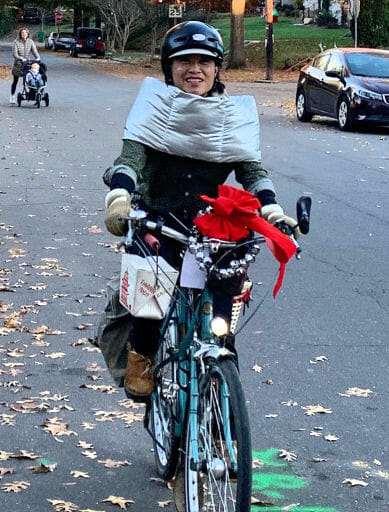
Dressed for success. What is that silvery thing?
Rule of thumb: A short-sleeved T shirt is good at mid-60’s and above, with arm warmers. When temperatures are in the low 60s, I need fingerless gloves, too. When it’s in the 50s, I wear a long-sleeved shirt, or short-sleeved with two pairs of arm warmers.
Wearing arm warmers provides an advantage. I can pull them down to my wrists as I warm up, without having to step off the bicycle or perform a worrisome no-hands-riding routine to strip off a piece of clothing.
Basically, instead of a jacket, I wear all the parts of a jacket without the back, so I don’t get sweaty and cold. If I have double layers of arm warmers, pulling one down usually dials in the perfect body temp so I don’t sweat.
If I go inside somewhere, I can easily take the arm warmers off and stow or carry them, since they’re not as big as a jacket.
Yes, these are a lot of pieces to keep up with, but I find this system worth wearing to stay warm and dry in all weather. I occasionally lose a few things, but I usually go back and find them.
When it gets below 40, I wear a jacket.
Add a layer for each 10-degree drop.
A thick layer counts as two layers. For example, I have a thick boiled-wool sweater that is as warm as a jacket, but needs a wind-block on the front. A golf shirt or light windbreaker works well as the wind-block.
I also have a thick wool poncho I like because it has a kangaroo pocket so I can warm my hands when I get off the bike.
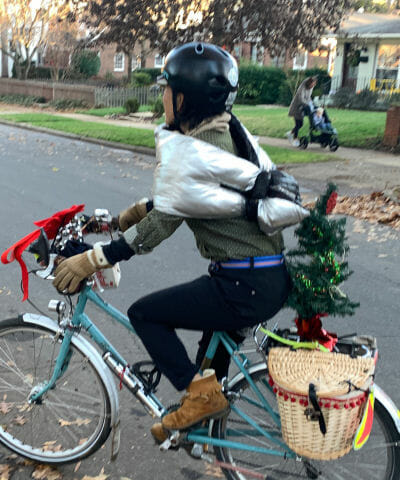
Christmas tree delivery: the silvery thing is a down-filled “infinity scarf” that ties up in the back so it stays in place.
Leg warmers.
Below 55 degrees, I need an additional layer on my legs. I have one thick and one thin pair of leg warmers. If it’s really cold, I wear both pairs, one over the other.
Leg warmers, like arm warmers, are easy to pull down if I get hot. I avoid wearing long johns. It’s a pain to take them off. If I leave them on, I sweat and get cold when I get back on my bike.
My expandable helmet.
I have a helmet with a spin dial that allows me to accommodate a thin hat underneath. I only do this when it’s really cold; otherwise it will cause me to sweat. A friend crocheted a pair of ear flaps for me that attach to the helmet liner and chin strap.
My extremities get cold, so I have fingerless gloves for temps in the 60s, leather gloves for the 50s. Glove liners offer more warmth.
In extreme cold weather, I wear overmitts. I have ski gloves, but those are useful only when temps are in the 40s or lower. I don’t like to layer them, and they’re too bulky.
Put the sweater over the jacket.
I want to be able easily to remove or pull down layers from the outside. This means wearing my sweater over my jacket. I know this sounds like it would look stupid, but it’s easier to remove the sweater than taking both off in the cold — and then getting cold.
The best way to deal with a day’s constantly-changing temps.
Ride a bike with carrying capacity. The temperature will rise during the day until the sun goes down, then get colder. Being able to stow gear easily makes it easy to adjust.
Bonus: When in doubt, it’s easy to carry something extra. If you sweat too much, you may need a dry shirt. Carry an extra.
My all-weather cycling system:
| Cold | Up to 100 degrees F. | 60-69F | 50-59F | 40-49F | 30-39F | 20-29F |
| Top | Wicking top | Short- sleeve T shirt | T shirt amd arm warmers | Short sleeve shirt, two pairs arm warmers | Add Wool primaloft vest | |
| Bottoms | Wicking shorts | Shorts | Pants | Pants, thin leg warmers on top of pants | Leg warmers on top of pants | Add down shorts |
| Shoes | Vibram Five Fingers | Vibram Five Fingers | Uggs boots | Uggs boots | Add thick wool socks | 2 pairs of socks |
| Hands | May need gloves | Fingerless gloves | Shearling gloves | Add overmitts | Add overmitts | |
| Arms | Arm Warmers – add below 65 | |||||
| Outer | Down scarf | Down scarf | Warm windproof jacket | Warm windproof jacket | ||
| Head | Wool hat w/ear flaps | Down hat w/ear flaps | ||||
| Neck | May need neck gaiter | Possum wool neck gaiter | Possum wool neck gaiter | Possum wool neck gaiter | Possum wool neck gaiter |



My biggest tip for cold weather: Take notes!
People and climates are very different, so everyone will experience a lot of trial and error. I suggest writing down what you wore for what combination of temperature, wind, sun etc. and how well it worked. Then summarize in a table like Pam’s. I did this long ago. It’s been very handy!
Hello Pam. Thanks for the tips. I am so impressed with the > 6,000 miles/year!
I rode thru a couple of Michigan winters a while back. I just took it one day at a time to see how it goes and it worked out great! They were quick with snow plows so I never rode in the snow but it gets dangerously cold so I had to occasionally wear face protection and quality boots/gloves.
The year before was 9,000 miles.
You’re right. Trial and error over many iterations help you figure it out. It’s a process.