

Bicycling in Winter Road Conditions
I live in Westbrook, Maine, a suburb of Portland. We had a few winter storms here last month.

Navigating with my non-studded hybrid tires under winter road conditions always makes me grateful to have a Savvy Cyclist’s confidence to choose the roads and the position on those roads that works best when there is ice and slush. The choices are not always the same ones I make in good weather.
This is not a general introduction to winter cycling. To place this article in context, here are some related articles that you may also wish to check out:
- Josh Stevens testifies to how he is Empowered for Unlimited Winter Travel in Michigan
- Pamela Murray explains her All-Weather Cycling System
- Here is a similar article to this one that I wrote back in 2018, Navigating Snowy Streets
- John Allen goes into detail on winter bicycle setup and maintenance (on sheldonbrown.com).
Winter Road Conditions
When I set out in messy winter weather, the first challenge starts at the end of my driveway. (I don’t count the driveway itself as a challenge because I can always walk my bike down it. Bonus: You don’t have to shovel the driveway to just get your bike out!)
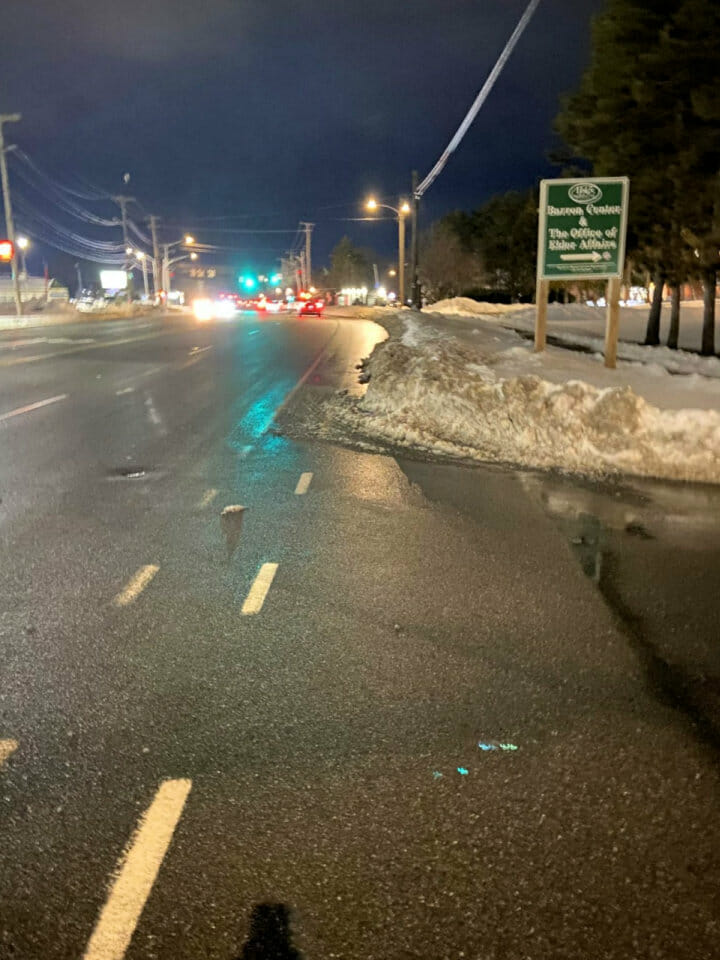
The streets in my neighborhood looked like the photo at the right as I started out to the grocery store one night in late January.
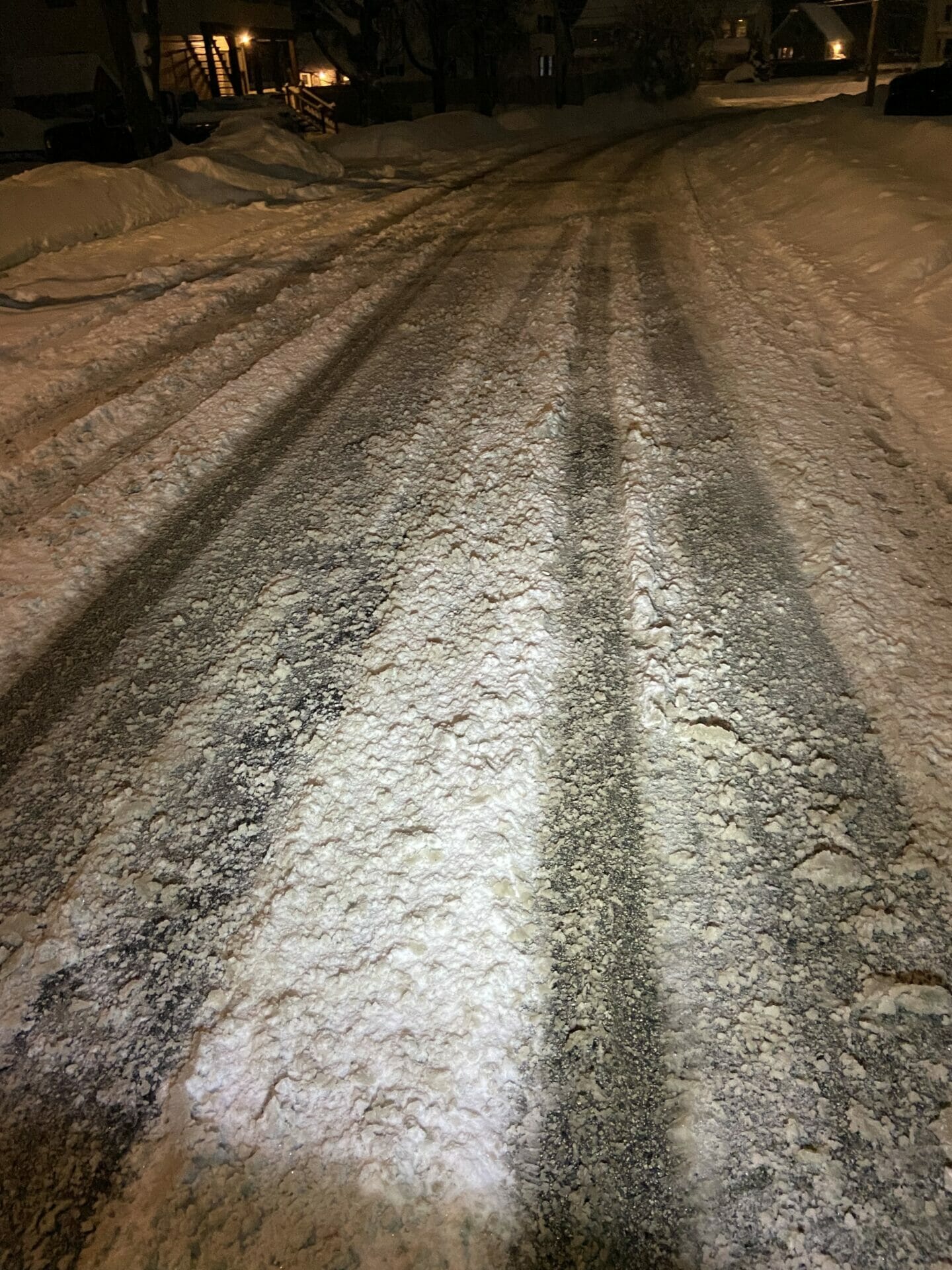
To the extent that any part of this street can be described as clean, it is the car tire tracks. Even in warm, dry weather, the travel lane is usually cleaner than the edge of the road, or the bike lane if there is one. This is because car tires tend to sweep things aside, making the travel lane somewhat “self cleaning”. Under winter road conditions, frequent car traffic has a similar effect. It’s not so much sweeping, unless the snow is really dry. But car tires compress wet snow into slush, and may partially throw it off to the side. They may melt it if the temperature is near or above freezing. This leads to the somewhat “clearer” tire tracks you see here.
Choosing a Route
After I’m on the street, I must next choose what route to take to my destination. It’s always much nicer to bicycle on quiet residential streets, right? Well, except in this weather, all of those streets are going to look just like the one above. Although the tire tracks are better than the middle or edges, they are still usually a bit slippery. The occasional pavement hazards like cracks and potholes increase the risk. Slush may even hide them! All in all, riding under these conditions is annoying, and you often have to go very slowly.
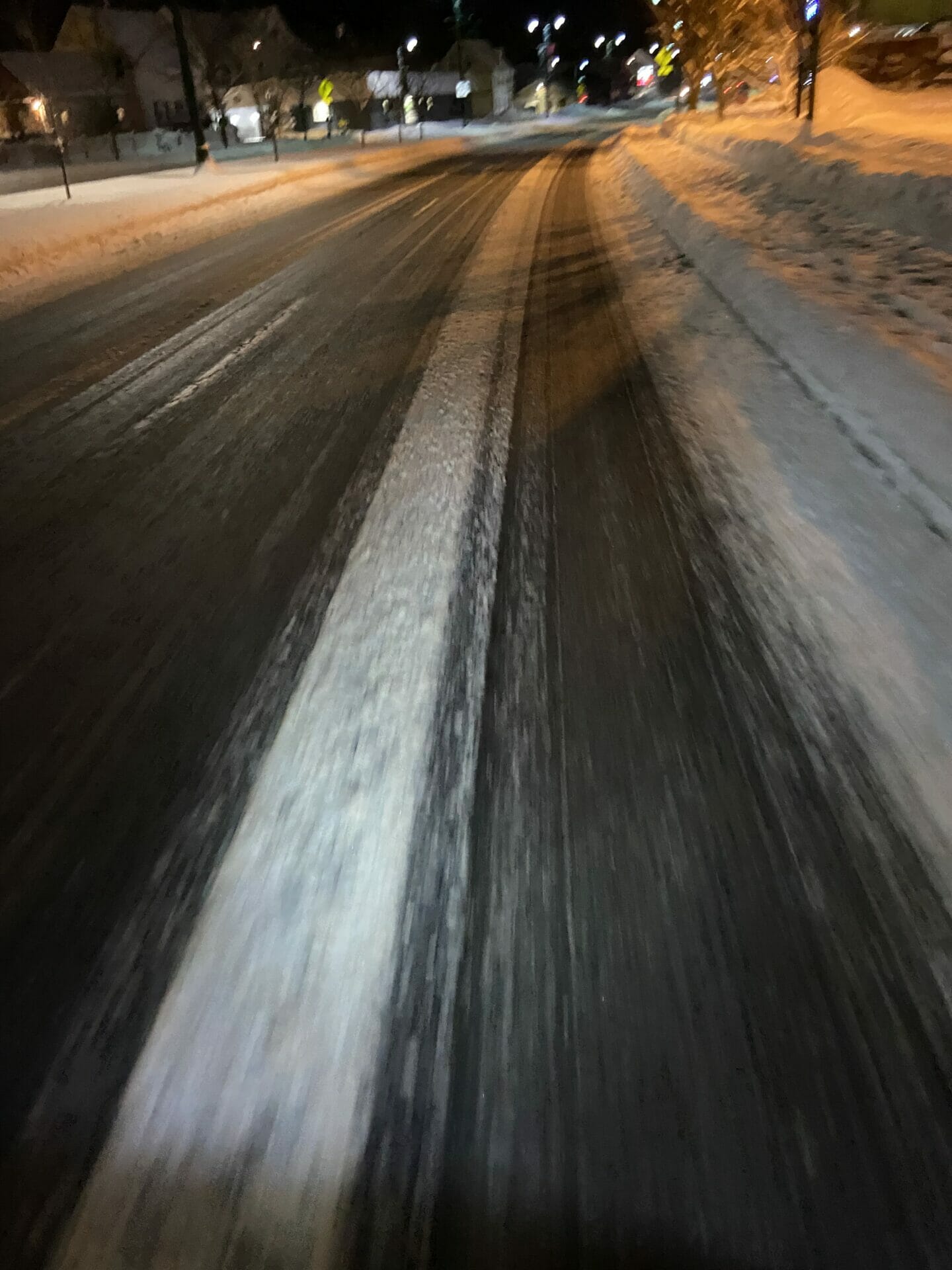
“Fortunately”, arterial roads are usually in better shape! The faster and more frequent traffic helps to clean them up faster, even with the same amount of plowing. (And even if it seems unfair, they usually get more frequent plowing too.) Here’s the 35 MPH arterial street I took to the grocery store that night. It still had snow in the middle and at the edge, but the tire tracks were mostly just wet, and it was much easier to see potholes and cracks. It was much less slippery than the smaller streets.
So here’s a reason you might actually choose an arterial! (And there are more.)
Winter Road Position
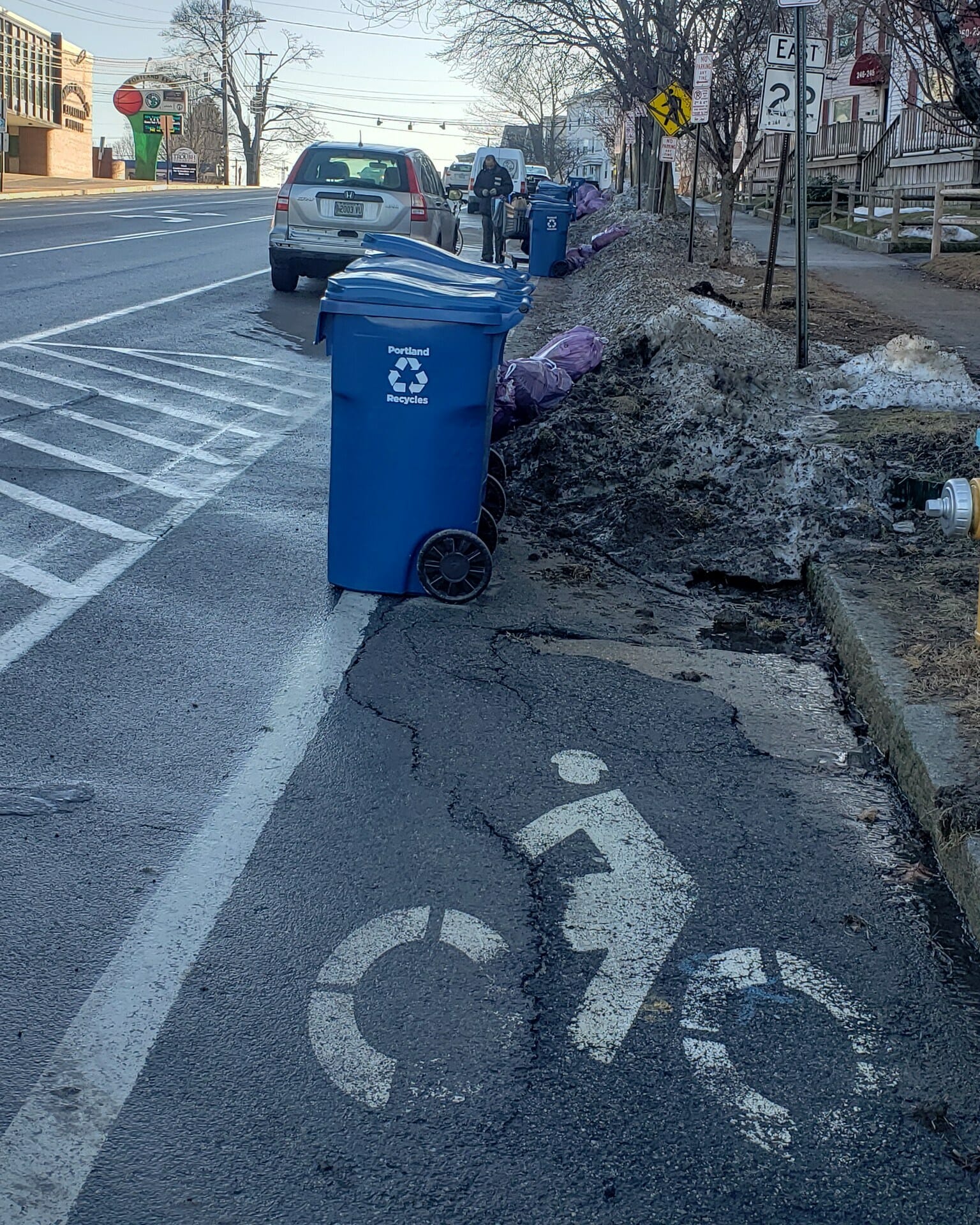
In both photos so far, you can see that the tire tracks are the cleanest position. There was no clear space at all at the edge. Of course some roads have wider shoulders or bike lanes. Plow truck drivers do usually make a decent attempt to clear shoulders and striped bike lanes, at least around here. Separated lanes are another story, because they require special equipment. Some cities are better than others in this regard. Around here, it’s not very reliable. Here’s what Portland’s parking-separated bike lane looked like recently. Also consider that separated lanes don’t get the car tire cleaning effect, and often don’t get as much direct sunlight to help with melting.
Bike Lanes and Shoulders
Even shoulders and traditional bike lanes are not necessarily reliable soon after a storm, evidenced by these sections I encountered while biking home a few days after one of last month’s storms.
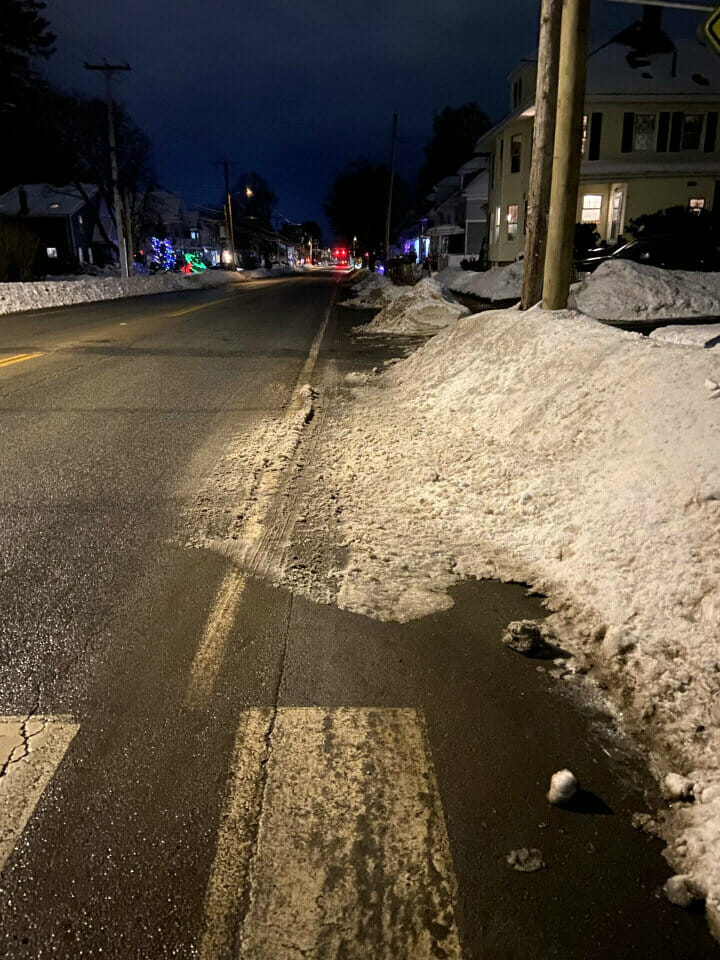
So, even with a shoulder or bike lane, I sometimes had to ride in the travel lane, even if just briefly to pass icy edge obstructions.
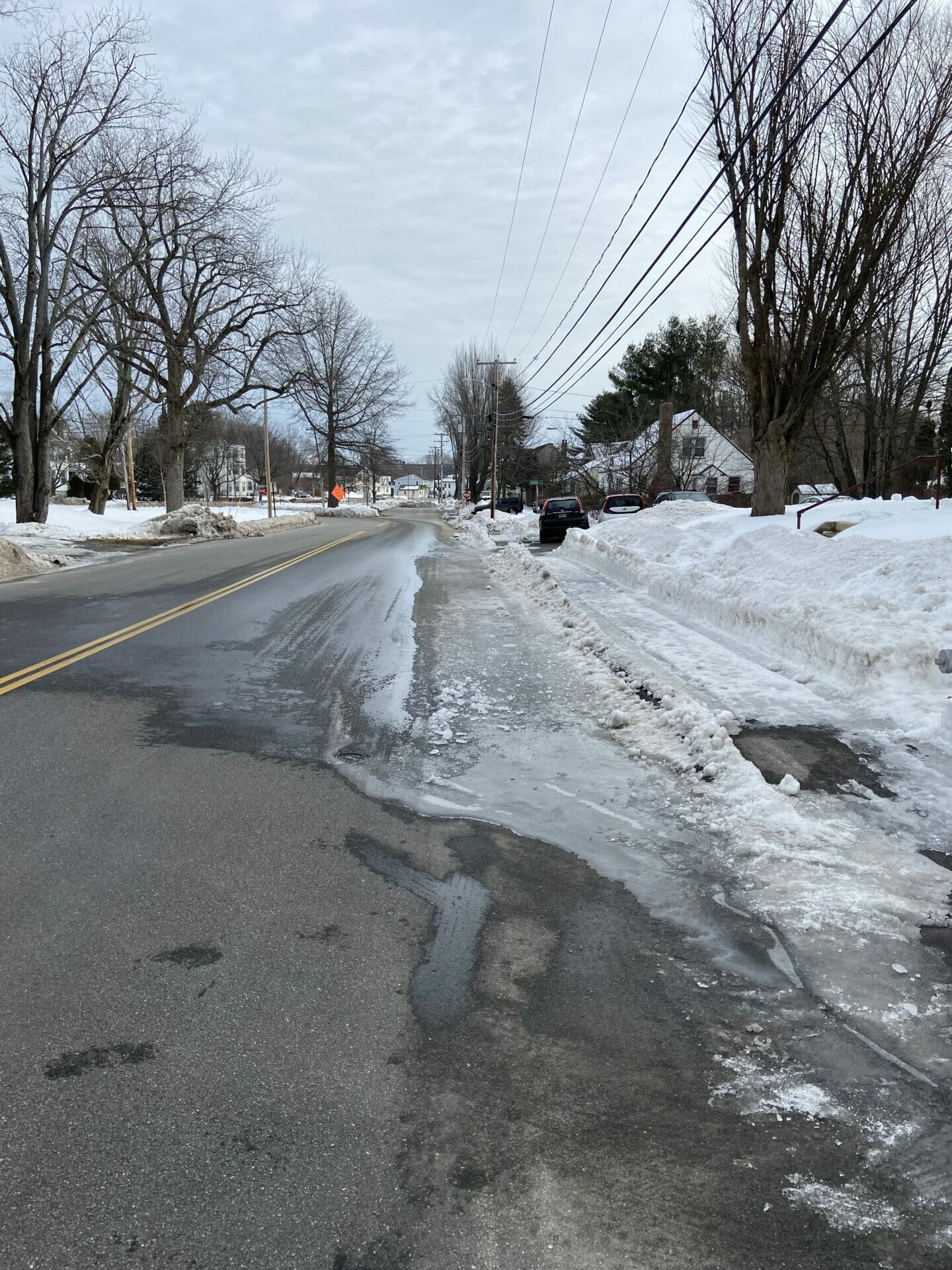
Even within the travel lane, you may find a need to maneuver to a different position. The collector street (below left) presented such a situation about two days after the storm. As poor drainage pooled, melting snow refroze overnight.
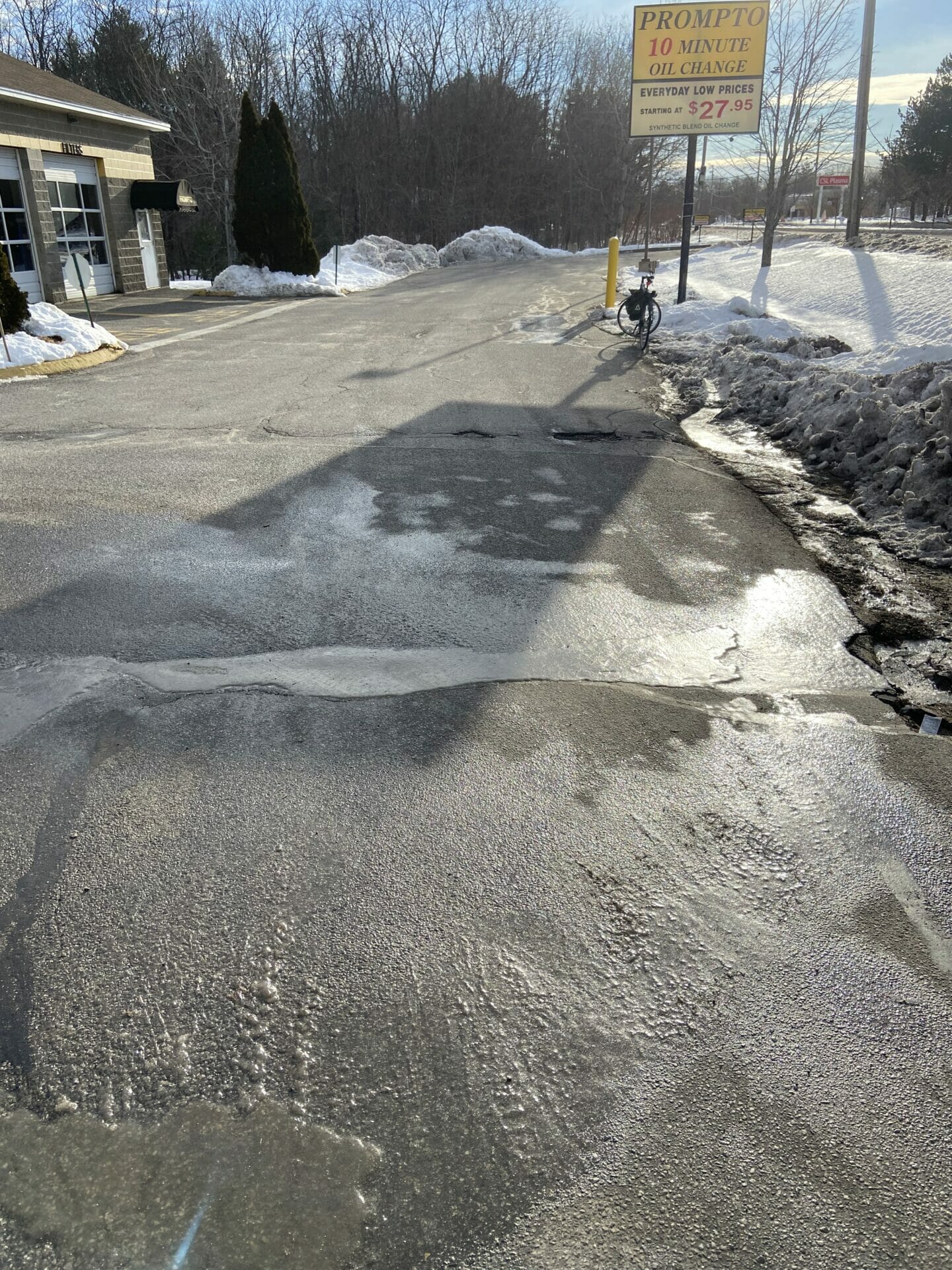
Sometimes, you just can’t avoid traveling over a small (hopefully) patch of ice, such as this driveway (above right) leading out of a doughnut shop on my way to work.
I’ve found that I can make it through such small sections of ice, even without studs, by just coasting without pedaling, being careful to keep the front wheel straight. If you are paying enough attention to see an ice patch ahead of time, you may also be able to stop, dismount, and walk it.
The Takeaway
As you can see, riding under winter road conditions requires constant awareness of the road surface, and the ability to adjust your position accordingly. A saving grace of riding during or just after a winter storm is that often there are fewer other people on the road, especially at night, and they are often more careful around you (in my experience). As always, communication with others is valuable. A more assertive lane position makes you more relevant to those around you, and in these road situations, gives you more maneuvering room to adjust your position as the condition of the road surface varies.
With these skills that we emphasize in CyclingSavvy, even cycling in winter road conditions can be fairly low-stress. Not everyone would call in enjoyable, especially given that it’s also cold, but with some attitudinal and clothing preparation, it can provide a great sense of accomplishment and independence!
John has ridden for transportation year-round in the Portland, Maine area for over 20 years.





Abso true! Thanks for saying it, that the safest option is often the main roadway.
Not just in snow. They are also maintained in other ways, more likely to be cleared of debris, more likely to be lighted, repaired, and so on.
And you get far better visibility too. By contrast, right-turning traffic often does not see bikes in an adjacent bike path.
All true. Thanks for commenting.
Nice writeup. But…. I never respond but in this case I just can’t help myself I’ve been cycling since 1972. I’ve cycled in winter almost every year since about 1983 in the Boston area. Sure you can ride without studded tires and do fine. But at this stage of the game at 56 years old- WHY? why take the chance? I have about 15 bikes and my 1992 Chris Fat Chance has 2 sets of wheels one normal one studded; my 1983 Specialized Expedition has also 2 sets of wheels. If there is any hint – any hint that there could be black ice or a possibility of any snow or ice – I go studded! I use weather.com hourly and also have a thermometer. Even then one must access the wind as wind can quickly turn moisture to black ice. I’d rather be wrong using studded tires and say oh well I made a mistake now I have to listen to 240 studs and deal with less performance in the dry- OH WELL GOT IT WRONG. THIS verses being out on the bike with normal tires and OPPS there’s black ice or… wait is that ice or not question…. this is just uncomfortable for me anyway.
Maybe it’s just me but why on earth take a chance or being laid up in hospital – it just isn’t worth it. at 21 years old, ya I rode a mountain bike through the worst no studs and later on used tires with silca in them like the Michelin Sprint green jobs- remember those? these did OK. But a 32mm 240 spike tire like the Marathon WInter – gosh theres no comparison.
if there is any moisture and a condition that could turn it black ice, I will not take a chance. If there is snow slush like you describe, I’d still use studs, why not?
I have used studs off and on, but I never liked the idea of putting them on my regular bike and using them every day, as many people do. Most days I actually don’t need them, especially as my commuting route is a lot of suburban roads that are generally clean apart from storms. I just don’t want to ride them on dry pavement so much of the time.
So at times, I did actually have a separate bike with them, a used mountain bike, and just took that bike when I felt I needed the studs. Having separate tires that I just swap out on the normal bike didn’t seem a great solution because it seemed most studded tires were mountain bike width and my normal commuter is a hybrid. It’s even less of a solution now that my commuter has internal hub gearing in the back, and a newly installed generator hub in front.
I no longer have that mountain bike and haven’t replaced it, but I’m finding that I need the studs even less frequently now because (1) since the pandemic, I’m working from home one day a week, which is lovely when it coincides with a bad weather day; (2) as of a few years ago, there is now a bus route that is almost exactly my commuting route, so I can and sometimes do take that in bad weather (usually still biking to and from the stops; the buses all have racks); and (3) our winters are by and large not as bad as they used to be, due I believe to climate change. So all in all, I just haven’t felt compelled to get new studs. (Probably the fact that as I’ve gotten more skilled, and use more of the travel lane than I used to, I’ve fallen less and less, is making me lazy about bothering with studs too. I didn’t even mention road crowning, another winter edge hazard which got me a few times in the early days. A literal slippery slope that you can slide right off of sideways, into the snow bank!)
By all means, use them if you want. I’m certainly not advocating not doing so. But I’m also cognizant that not everyone will go to the trouble, be that prepared, nor indeed, in some cases, may have the money to do so. I do like to keep things simple, notwithstanding my adoption of hub gearing and generation. I guess I feel like I want those more than studded tires at this point. The internal hub is great because I suck at maintenance, and the generator hub because I love not having to recharge USB lights every single day anymore. (Though I still carry them with me as backup, or for when I feel the need to augment in especially poor visibility.)